Auditorium Experts
by auditoriumworks
Jul 08, 2026


When people think about auditorium acoustics, their attention often goes directly to sound systems, speakers, amplifiers, and microphones. While these components are important, the quality of sound inside an auditorium depends just as much on the room itself as it does on the equipment installed within it.
An auditorium with poor acoustic treatment can suffer from excessive echo, unclear speech, uneven sound distribution, and listener fatigue regardless of how advanced the sound system may be. On the other hand, a well-designed auditorium can deliver excellent speech clarity and balanced sound performance even with modest audio equipment.
Among the various elements that influence acoustic performance, acoustic panels play one of the most important roles.
However, selecting acoustic panels is not as simple as choosing a design, color, or manufacturer. Different auditoriums have different acoustic requirements based on room volume, seating capacity, intended use, architectural design, and performance expectations.
This guide explains how acoustic panels work, the factors that influence panel selection, and the key considerations that architects, consultants, institutions, and project owners should evaluate before specifying acoustic treatments for auditoriums and theaters.
Why Acoustic Panels Are Essential in Auditoriums
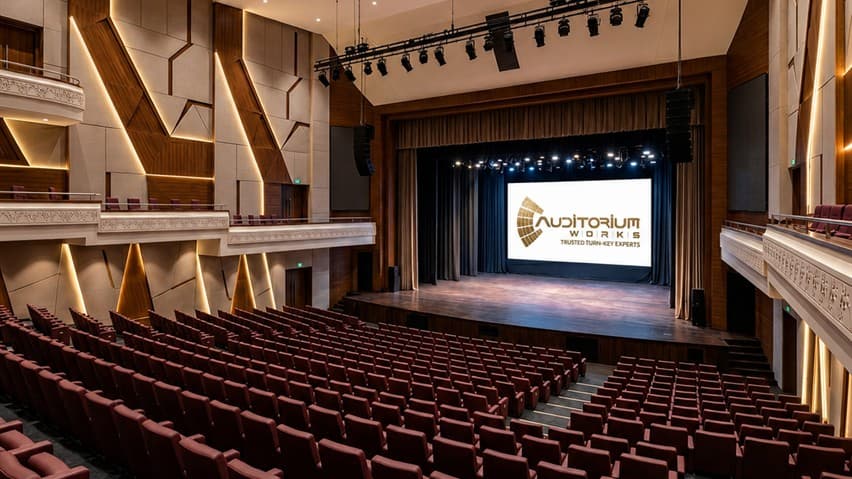
Every sound produced on stage interacts with the surrounding surfaces before reaching the audience.
When sound waves strike hard surfaces such as concrete, marble, glass, gypsum, or wood, they reflect back into the room. These reflections combine with direct sound and can create reverberation, echo, and loss of speech intelligibility.
In auditoriums used for lectures, presentations, educational events, conferences, and cultural performances, excessive reverberation can make it difficult for audiences to understand spoken content.
Acoustic panels help control these reflections by absorbing a portion of the sound energy. This creates a more balanced listening environment and improves overall acoustic quality.
The goal is not to eliminate reflections entirely. Instead, acoustic panels are used to manage reflections so that sound remains clear, natural, and evenly distributed throughout the venue.
Understanding the Purpose of Acoustic Panels
One of the biggest misconceptions in auditorium design is that acoustic panels are primarily decorative products.
While modern acoustic panels are available in attractive finishes and architectural designs, their primary purpose is acoustic performance.
Acoustic panels help:
Without proper acoustic treatment, even the most visually impressive auditorium may fail to deliver an acceptable listening experience.
Start by Understanding the Auditorium’s Purpose
Before selecting any acoustic panel system, it is important to identify how the auditorium will be used.
Different venues require different acoustic characteristics.
Educational Auditoriums
Schools, colleges, universities, and training centers primarily focus on speech clarity.
In these environments, acoustic panels are selected to reduce reverberation and improve intelligibility so that every audience member can clearly understand presentations and lectures.
Cultural and Performing Arts Venues
These auditoriums often host music performances, dance programs, theatrical productions, and cultural events.
The acoustic design must balance speech clarity with musical richness, requiring careful placement and selection of acoustic treatments.
Conference and Convention Halls
Corporate events, seminars, and conferences require excellent voice reproduction and minimal background reflections.
Acoustic panels play a critical role in supporting presentation quality.
Multi-Purpose Auditoriums
Many modern auditoriums accommodate multiple event types.
These venues require flexible acoustic solutions capable of supporting both speech-based and performance-based activities.
Understanding the intended use of the space is the first step toward selecting the right acoustic treatment strategy.
Types of Acoustic Panels Used in Auditoriums
Several types of acoustic panels are commonly used in auditorium and theater projects.
Fabric-Wrapped Acoustic Panels
These are among the most popular solutions in modern auditoriums.
They typically consist of a sound-absorbing core wrapped in decorative fabric finishes. They offer excellent acoustic performance while providing extensive customization options.
Wood Acoustic Panels
Wood acoustic panels combine aesthetics with functionality.
Perforated or slotted wooden surfaces allow sound to pass through to the absorptive backing material, creating an effective acoustic treatment solution.
They are frequently used in premium auditoriums, theaters, and cultural centers.
Polyester Acoustic Panels
Polyester panels are lightweight, durable, and available in a wide range of colors and designs.
They are often used where contemporary aesthetics and sustainability are important considerations.
Custom Acoustic Systems
Large auditoriums may require project-specific acoustic solutions developed through detailed acoustic analysis and performance modeling.
These systems are designed to address the unique acoustic requirements of the venue.
The Importance of NRC Ratings
When comparing acoustic panels, one of the most important performance indicators is the Noise Reduction Coefficient (NRC).
NRC measures how effectively a material absorbs sound energy.
| NRC Rating | Performance Level |
| 0.20 – 0.40 | Limited absorption |
| 0.50 – 0.70 | Moderate absorption |
| 0.70 – 0.90 | High absorption |
| 0.90 – 1.00 | Excellent absorption |
Higher NRC values generally indicate better sound absorption performance.
However, selecting the highest NRC panel available is not always the best approach. Acoustic design requires balance. Excessive absorption can make an auditorium sound acoustically dead and lifeless.
The objective is to achieve the appropriate acoustic environment for the intended use of the venue.
Choosing the Right Panel Thickness
Panel thickness has a significant impact on acoustic performance.
Thicker panels generally provide better low-frequency absorption and broader acoustic effectiveness.
Common panel thicknesses include:
| Thickness | Typical Application |
| 25 mm | Light acoustic treatment |
| 50 mm | Standard auditorium applications |
| 75 mm | Enhanced acoustic performance |
| 100 mm+ | Large venues and specialized applications |
The appropriate thickness depends on room volume, acoustic objectives, and frequency control requirements.
Acoustic Panel Placement Matters More Than Quantity
A common mistake is assuming that more panels automatically result in better acoustics.
In reality, placement is often more important than the number of panels installed.
Acoustic consultants typically evaluate:
Strategic placement ensures that acoustic panels address problematic reflection points while maintaining balanced sound distribution throughout the venue.
This is why professional acoustic design relies on analysis rather than simply covering walls with absorptive materials.
Matching Acoustic Panels with Interior Design
Modern auditoriums are expected to perform acoustically while also creating a strong visual impression.
Fortunately, acoustic panels are available in numerous finishes, including:
This allows designers to integrate acoustic treatment into the architectural language of the space rather than treating it as a separate technical component.
The best auditorium designs successfully combine aesthetics and performance.
Common Mistakes When Selecting Acoustic Panels
Several mistakes repeatedly appear in auditorium projects.
One common issue is selecting panels based solely on appearance without reviewing acoustic performance data.
Another mistake is treating every auditorium as if it has identical acoustic requirements. A lecture hall, performing arts venue, and conference auditorium often require different acoustic solutions.
Some projects also rely entirely on wall panels while ignoring ceiling treatments, diffusers, and room geometry.
Finally, many projects attempt to solve acoustic issues after construction rather than incorporating acoustic planning during the design phase.
These approaches often result in higher costs and reduced performance.
Why Professional Acoustic Design Matters
Acoustic panels are only one component of a successful auditorium.
Room geometry, seating layout, stage design, ceiling treatments, wall finishes, sound systems, and mechanical services all influence the acoustic environment.
Professional acoustic consultants use modeling, calculations, and performance analysis to determine the most effective treatment strategy for each project.
This approach ensures that acoustic panels are selected and positioned based on measurable performance objectives rather than assumptions.
For large auditoriums and theaters, professional acoustic planning can significantly improve both user experience and project outcomes.
Conclusion
Choosing the right acoustic panels for an auditorium or theater involves far more than selecting a product from a catalog.
The most effective acoustic solutions are based on a thorough understanding of the venue’s purpose, room characteristics, performance goals, and architectural requirements.
By evaluating panel type, NRC rating, thickness, placement strategy, and overall acoustic objectives, project teams can create environments that deliver exceptional speech clarity, balanced sound distribution, and an enhanced audience experience.
Whether designing an educational auditorium, cultural center, performing arts venue, conference hall, or multi-purpose theater, investing in the right acoustic panel system is a critical step toward achieving long-term acoustic success.
Frequently Asked Questions (FAQ)
What are acoustic panels used for in auditoriums?
Acoustic panels reduce unwanted sound reflections, improve speech clarity, and enhance overall acoustic performance.
What is the best acoustic panel material for auditoriums?
Fabric-wrapped panels, wood acoustic panels, and polyester acoustic panels are among the most commonly used solutions.
What NRC rating should auditorium acoustic panels have?
Most auditorium applications use panels with NRC ratings between 0.70 and 1.00, depending on acoustic requirements.
Are acoustic panels and soundproofing the same?
No. Acoustic panels improve sound quality within a room, while soundproofing reduces sound transmission between spaces.
How many acoustic panels does an auditorium need?
The required quantity depends on room size, volume, acoustic objectives, and surface materials. Professional acoustic analysis is recommended.
Can acoustic panels improve speech clarity?
Yes. Properly designed acoustic treatments significantly improve speech intelligibility and audience comprehension.
Are wood acoustic panels effective?
Yes. Perforated and slotted wood acoustic panels provide both aesthetic appeal and effective acoustic performance.
When should acoustic panels be planned in an auditorium project?
Ideally during the design phase, before construction begins, to ensure optimal integration with architectural and engineering systems.
Contact Auditorium Works
Planning an auditorium, theater, lecture hall, cultural center, convention facility, or performing arts venue?
Our team specializes in auditorium planning, acoustic design, technical consulting, soundproofing solutions, seating layouts, stage infrastructure, and complete auditorium execution services.
Phone: +91 90150 60000
Email: auditoriumworks@gmail.com
Contact us today to discuss your auditorium project and discover how the right acoustic solutions can enhance audience experience, speech clarity, and overall venue performance.
Speak directly with our turnkey engineering team for acoustic design, stage lighting specifications, BOQ estimation, and turnkey delivery.
Auditorium Works delivers turnkey auditorium planning, consulting, engineering, and execution. We integrate acoustics, AV systems, stage lighting, machinery, seating, and interiors into one coordinated delivery path from concept to commissioning.
Share Your Query